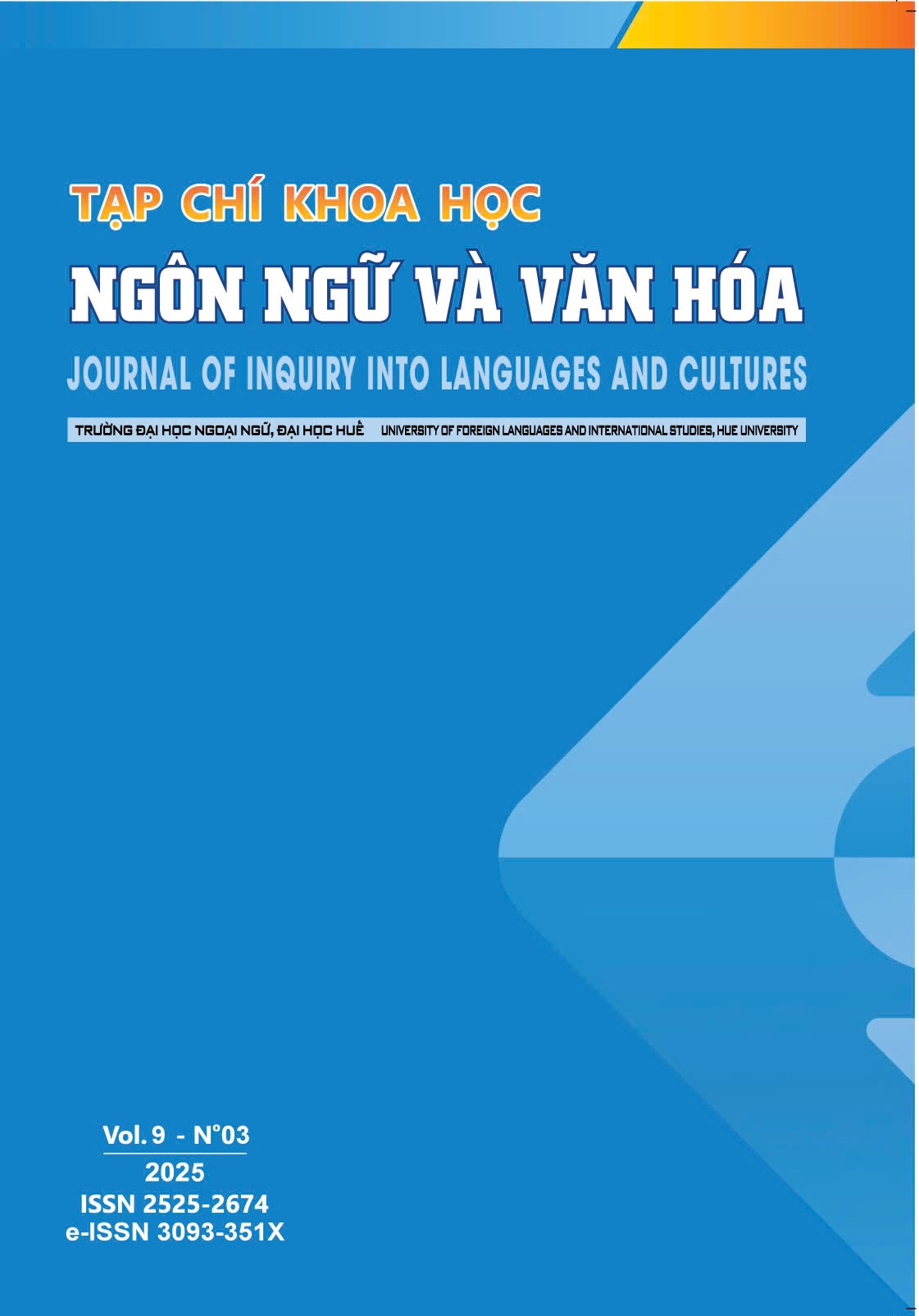
PERCEPTIONS OF KOREAN LANGUAGE AND CULTURE STUDENTS ON THE USE OF ADVERBIAL CASE PARTICLES IN KOREAN
DOI:
https://doi.org/10.63506/jilc.0903.410Keywords:
Particles; adverbial case particles; learner perception; 에/에서; Korean languageAbstract
This study examines the perceptions of 100 second-year students majoring in Korean Language and Culture regarding the use of the adverbial case particles “에” and “에서” in Korean. Using data analysis and comparative methods, the study aims to clarify students’ levels of awareness of the semantic functions of these two particles, their ability to apply them in actual usage, and their capacity to distinguish between overlapping semantic functions. The findings indicate that students’ awareness of the semantic functions of “에/에서” is uneven: more familiar functions are recognized more effectively, whereas more abstract or easily confusable functions remain challenging. Based on these findings, the study proposes several pedagogical directions to enhance learners’ understanding and accurate use of adverbial case particles in Korean language teaching and learning.
Downloads
References
Baek, I. (2022). Error analysis and educational support plan for Vietnamese Korean learners’ use of the adverbial case marker: Focusing on the use error of ‘e’ and ‘eseo’ in the investigation. Korea Open Access Journals, 13(3), 1645-1660.
Bian, X. (2010). A study on the teaching method and plan about the Korean particles system [Master’s thesis]. Department of Korean Language and Literature, Graduate School, Myongji University.
Gungnip Gukeowon. (2021). Pyojun Gugeo Daesajeon [Từ điển chuẩn tiếng Hàn]. http://stdweb2.korean.go.kr/main.jsp
Gye, E., & Kim, Y. (2019). The perception of Korean adverbial case markers ey, eyseo, ro: A self-paced reading study. Bilingual Research, 77, 37–64.
Heydari, P., & Bagheri, M. S. (2012). Error Analysis: Sources of L2 learners’ errors. Theory and Practice in Language Studies, 2(8), 1583-1589.
Jin, J. (2015). A comparative analysis on particles and complex particles in Korean textbooks published in Korea and China [Master’s thesis]. Chosun University.
Josa. Bách khoa toàn thư Văn hóa Dân tộc Hàn Quốc (한국민족문화대백과사전). https://encykorea.aks.ac.kr/Article/E0051845
Kang, Y. (2015). Junggugin hakseupjareul wihan Hangugeo busagyeok josa ‘e’, ‘eseo’, ‘ro’ui gyosu·hakseup bang-an yeongu [Nghiên cứu phương án giảng dạy các tiểu từ bổ ngữ ‘에’, ‘에서’, ‘로’ dành cho người học tiếng Hàn là người Trung Quốc] [Master’s thesis]. Seoul National University.
Kim, H. J., Lee, I. K., Park, E. S., & Kim, M. Y. (2010). Ehwa hangugeo 2-2 [Tiếng Hàn Ewha 2-2]. Ewha Womans University Press.
Kim, H. J., Lee, M. H., Koo, J. H., Lee, S. H., Kwon, K. M., & Yoo, S. H. (2010). Ehwa hangugeo 1-1 [Tiếng Hàn Ewha 1-1]. Ewha Womans University Press.
Kim, H. J., Lee, M. H., Koo, J. H., Yoo, Y., Lee, S. H., & Kwon, K. M. (2010). Ehwa hangugeo 1-2 [Tiếng Hàn Ewha 1-2]. Ewha Womans University Press.
Kim, J. (2006). Error analysis in the uses of particles and verb endings of advanced Korean-learning English speakers. Teaching Korean as a Foreign Language, 31, 129–152.
Kim, J. S., Park, D., Lee, B. G., Lee, H. Y., Jeong, H. J., Choi, J. S., & Heo, Y. (2005). Oegugin-eul wihan Hangugeo munbeop 1 - Yongbeop pyeon [Ngữ pháp tiếng Hàn cho người nước ngoài 1 – Phần cách dùng]. Communication Books.
Kim, J. S., Park, D., Lee, B. G., Lee, H. Y., Jeong, H. J., Choi, J. S., & Heo, Y. (2005). Oegugin-eul wihan Hangugeo munbeop 2 - Yongbeop pyeon [Ngữ pháp tiếng Hàn cho người nước ngoài 2 – Phần cách dùng]. Communication Books.
Kim, J., & Lee, S. (2004). Junggan-eoneo gwanjeom-eseo hangugeo haksseupja-ui josa oryu yeongu: eul/reul, i/ga, e, eseoreul jungsimeuro [Nghiên cứu lỗi sử dụng tiểu từ trong tiếng Hàn của người học dưới góc độ liên ngôn ngữ: tập trung vào 을/를, 이/가, 에, 에서]. Bilingual Research, 24, 87–108.
Kim, Y., & Lee, Y. (2021). Aspects of case marker perception of Spanish-speaking learners of Korean. Korean Language Education Research, 48, 29–62.
Nguyễn Thị Tuyết Nhung, Hoàng Thị Thao, & Trần Ngọc Đức (2022). Giải pháp nâng cao việc giảng dạy tiểu từ 이/가 và 은/는 cho sinh viên ngành Ngôn ngữ Hàn Quốc tại Đại học Công nghiệp Hà Nội. Tạp chí Ngôn ngữ - Viện Ngôn ngữ học, Viện Hàn lâm Khoa học Xã hội Việt Nam, 52-62.
Song, Dae-heon. (2014). Hangugeo gyoyugeul wihan busagyeok josa ‘e’, ‘eseo’ yeongu [Nghiên cứu về tiểu từ bổ ngữ ‘에’, ‘에서’ trong giảng dạy tiếng Hàn]. In Proceedings of the Department of Korean Language and Literature. Cheongju University.
Yu, D. S. (1998). Josa-ui sajeonjeok chori.
Yu, D. S. (2004). Josa [Tiểu từ]. Saeguk-e Saenghwal, 14(1). Department of Korean Language Education, Pusan National University.
Downloads
Published
Issue
Section
How to Cite