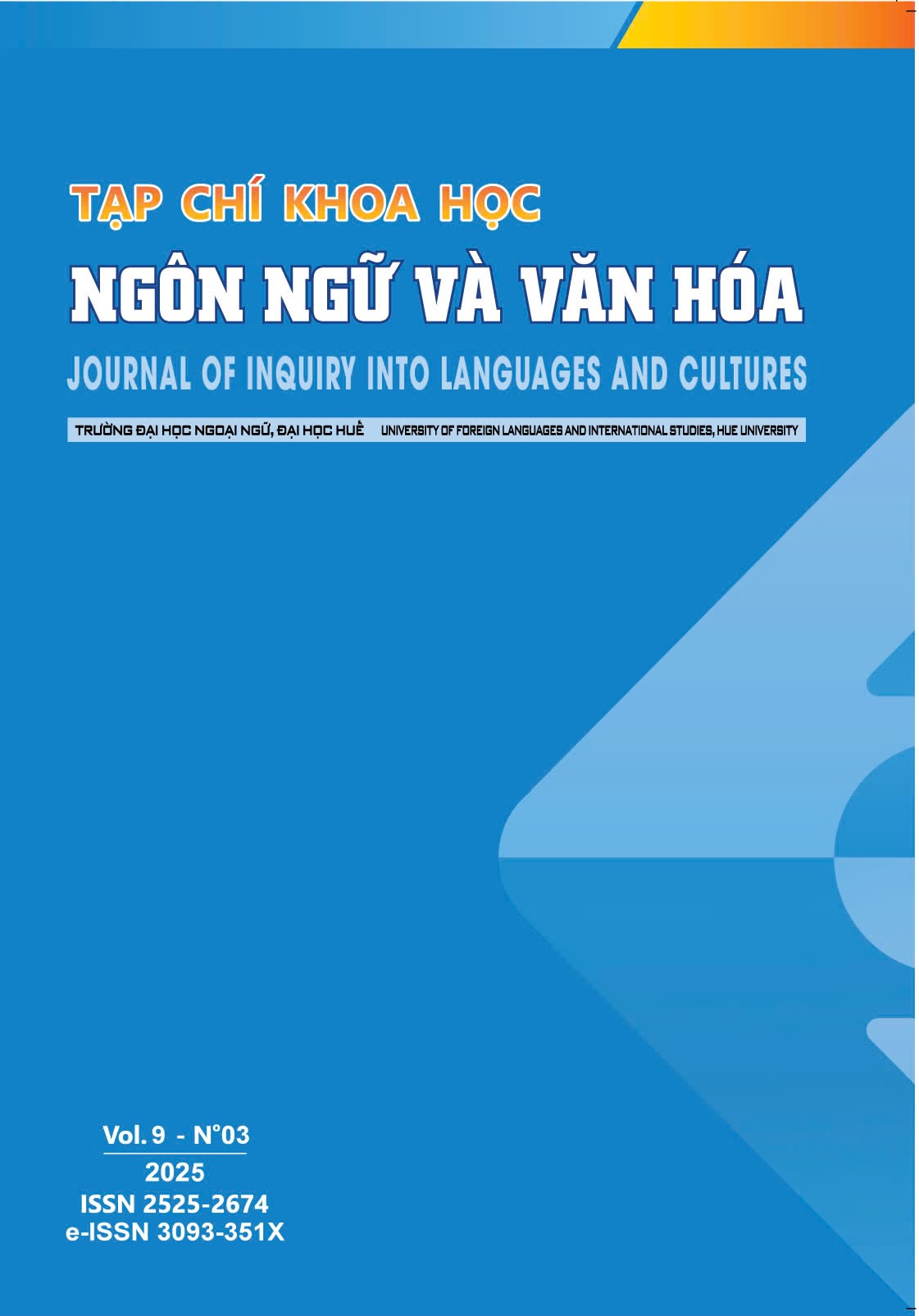
STUDENT’S PERCEPTIONS OF TEACHER’S USE OF FOLKTALES IN KOREAN READING COMPREHENSION INSTRUCTION
DOI:
https://doi.org/10.63506/jilc.0903.390Keywords:
Korean folktales; Reading skills; intermediate Korean language learnersAbstract
Adapted Korean folktales are characterized by simple vocabulary, repetitive structures, rich cultural elements, and high educational value, making them a valuable resource for Korean language instruction. Using a quantitative approach, the author conducted a survey of 103 intermediate-level Korean learners (TOPIK levels 3 and 4) from the Department of Korean Language and Culture. The findings reveal that learners highly appreciate the effectiveness of folktales in improving Korean reading comprehension skills, while also experiencing difficulties mainly related to vocabulary and expressions when reading Korean folktales. In addition, learners show particular interest in Korean folktales that share thematic similarities with Vietnamese folktales. The findings contribute to understanding learners’ perceptions of teachers’ use of Korean folktales in reading comprehension instruction.
Downloads
References
Bennett, M. J. (1993). Towards ethnorelativism: A developmental model of intercultural sensitivity. In R. M. Paige (Ed.), Education for the intercultural experience (pp. 21–71). Intercultural Press. https://www.scirp.org/reference/referencespapers?referenceid=2214053
Byram, M. (1997). Teaching and assessing intercultural communicative competence. Multilingual Matters. https://spada.uns.ac.id/pluginfile.php/253332/mod_resource/content/1/ICC%20Byram.pdf
Choi, W. S., & Kim, K. C. (1998). Jeonlaedonghwa gyoyuk-ui ireon-gwa silje [Lý thuyết và thực tiễn dạy học truyện cổ tích Hàn Quốc]. Jipmoondang Publishing.
Creswell, J. W. (2012). Educational research: Planning, conducting, and evaluating quantitative and qualitative research (4th edition). Pearson. https://www.scirp.org/reference/referencespapers? referenceid=757162
Dörnyei, Z. (2007). Research methods in applied linguistics: Quantitative, qualitative, and mixed methodologies. Oxford University Press. https://search.worldcat.org/title/Research-methods-in-applied-linguistics-%3A-quantitative-qualitative-and-mixed-methodologies/oclc/1342132852? utm_source
Duong, M. L. (2020). Beteunamin hangugeo hagsaeng-eul wihan eohwi gyojae gaebal bang-an yeongu [Phương pháp biên soạn giáo trình từ vựng cho người Việt học tiếng Hàn] [Luận văn Thạc sĩ]. Đại học Quốc gia Jeonbuk. https://m.riss.kr/link?id=T15680035
Han, S. A. (2003). Hanguk jeonlaedonghwa-e daehan hae-seokhakjeog ihae [Hiểu và phân tích truyện cổ tích Hàn Quốc] [Luận án Tiến sĩ]. Đại học Nữ sinh Seoul.
Jo, K. S. (1996). Hanguk jeonlaedonghwa-ui teukjing-gwa bumo-congye gwan-gye bunseok [Đặc điểm truyện cổ tích Hàn Quốc và mối quan hệ cha mẹ - con cái]. Hyejeon Jeonmundae Nonmunjip, 14, 463–481.
Joung, S. Y., & Shin, S. (2023). Jungguk daehak hangugeo jeon-gong hakseupjareul wihan hangukmunhak sueob hyeonhwang mit yogujoosa [Nghiên cứu về thực trạng và nhu cầu của người học tiếng Hàn chuyên ngành tại các trường đại học Trung Quốc]. Hanguk Eoneo Munhwa Hak, 20(3), 231–259. http://dx.doi.org/10.15652/ink.2023.20.3.231
Ju, E. J. (2002). Munhak teksseuteureul hwal-yonghan hangugeo gyoyuk yeongu [Phương pháp dạy tiếng Hàn sử dụng văn bản văn học] [Luận văn Thạc sĩ]. Đại học Kyung Hee. https://www.riss.kr/ link?id=T8548453
Kim, E. Y. (2021). Hanguk-eo gyojae-e jesidoen jeonlaedonghwa-e daehan sayongja insik josa yeongu [Nghiên cứu khảo sát nhận thức người dùng về truyện cổ tích được trình bày trong giáo trình tiếng Hàn]. Donghwa wa Beonyeok, 41, 103–133.
Kim, S. H. (2005). Jeonlaedonghwa-reul hwal-yonghan Hangugeo gyoyuk bang-an yeongu [Nghiên cứu về phương pháp giảng dạy tiếng Hàn sử dụng truyện cổ tích] [Luận văn thạc sĩ]. Đại học Korea. https://www.riss.kr/link?id=T10384571
Kim, T., Choi, W., Kang, D., Jeon, S., Yun, K., Jeong, S., & Han, C. (1995). Hanguk gubi munhak gaeron [Khái luận văn học truyền miệng Hàn Quốc]. Minsogwon.
Ko, M. K. (2005). Oegugeoro-seo-ui hangugeo gyoyukhak gaeron [Khái luận giáo dục tiếng Hàn như một ngoại ngữ]. Bakijeong Publishing.
Koo, M. J. (2013). Hanguk-eo ilg-gi gyoyukeul wihan tekstu nanido cheukjeongbeop yeongu [Nghiên cứu về phương pháp đo lường độ khó văn bản trong giảng dạy kỹ năng đọc tiếng Hàn] [Luận văn Tiến sĩ]. Đại học Catholic. http://www.riss.kr/link?id=T13040938
Koo, S. H., & Yoo, S. G. (2008). Gyeolhon imin-ja-reul wihan hangugeo·munhwa gyoyuk bang-an yeongu: Jeonlaedonghwa-reul hwaryonghayeo [Phương pháp giáo dục tiếng Hàn và văn hóa cho phụ nữ di trú thông qua truyện cổ tích Hàn Quốc]. Hangukeo Gyoyuk, 19(3), 45–64. https://doi.org/10.18209/iakle.2008.19.3.45
Kramsch, C. (1993). Context and culture in language teaching. Oxford University Press.
Kwon, M. J. (1999). Oegugeoro-seo-ui hangugeo ilg-gi gyoyuk - Dokhae jeollyag-eul tonghan hyoyuljeog-in il gi bang-an [Dạy đọc tiếng Hàn như một ngoại ngữ - Chiến lược đọc hiệu quả]. Hangukeo Gyoyuk, 10(1), 1–28. https://kiss.kstudy.com/Detail/Ar?key=1592410
Lee, D. S., & Park, S. H. (2019). A study on the reading anxiety of Vietnamese learners of Korean: The case of beginner and intermediate level learners. Hakseupja Jungsim Gyogwa Gyoyuk Yeongu, 19(18), 271–289. http://dx.doi.org/10.22251/jlcci.2019.19.18.271
Lee, Y. N. (1999). Jeonlaedonghwa-ui gyojewa yangsang yeongu [Nghiên cứu hình thức đưa truyện cổ tích Hàn Quốc vào giáo trình] [Luận văn Thạc sĩ]. Trường đại học Sư phạm Incheon.
Nguyễn Thị Ngọc Bích & Nguyễn Đức Long. (2021). Kỹ năng đọc hiểu tiếng Hàn Quốc
của sinh viên chuyên ngữ năm 2tại Trường đại học công nghiệp Hà Nội. Tạp chí Từ điển học và Bách khoa thư, 1(69), 124–130.
Nguyen, H. T. (2022). Jeonlaedonghwa-reul hwaryonghan hangugeo ilg-gi gyoyuk bang-an yeongu [Nghiên cứu phương án dạy kĩ năng đọc tiếng Hàn thông qua truyện cổ tích Hàn Quốc] [Luận văn Thạc sĩ]. Đại học Quốc gia Jeonbuk. https://m.riss.kr/link?id=T16096870
Nunan, D. (1999). Second language teaching & learning. Boston, MA: Heinle & Heinle.
Safitri, I. (2023). Exploring the utilization of folktales as reading materials for EFL students. Journal of English as a Foreign Language Education, 4(2), 115-125. https://jurnal.untan.ac.id/index.php /JEFLE /article/view/74899
Safitri, I. (2023). Exploring the utilization of folktales as reading materials for EFL students. Journal of English as a Foreign Language Education, 4(2), 133–143. http://dx.doi.org/10.26418/jefle.v4i2 .74899
Shin, Y. K. (2004). Munhakgyojae gaebal gijun-gwa seonjeon [Tiêu chí và lựa chọn giáo trình văn học]. Gukje Hangukeo Gyoyukhakhoe Gukje Haksulbalpyo Nonmunjip 2004, 441–450.
Simon, M. P. (2022). The benefits of using fairy tales in EFL classrooms. Asian Education Studies, 7(3), 1–7. https://doi.org/10.20849/aes.v7i3.1138
Son, D. I. (1984). Hanguk jeonlae donghwa yeongu [Nghiên cứu về truyện cổ tích Hàn Quốc]. Jeongeum Munhwasa.
Taylor, E. K. (2000). Using folktales. Cambridge University Press.
TOPIK. (n.d.). Official website of the test of proficiency in Korean. https://www.topik.go.kr
Woo, I. H. (2016). Hangugeo-ihae gyoyukron [Lý luận giảng dạy hiểu tiếng Hàn]. Hyungseul Publishing.
Yoon, K. A. (2017). Korean through folktales. Portland State University. https://pdxscholar.library. pdx.edu/cgi/viewcontent.cgi?article=1013&context=pdxopen
Downloads
Published
Issue
Section
How to Cite